Hoplomachia (2006 ed.)
Author: The Captain
Publisher: The Perfect Captain, 2003
Period: Ancient Greece
Scale: Midsize to Big Battle
LIBRARIAN'S SUMMARY
Hoplomachia is a free tactical miniatures game focused entirely on Classical Greek warfare from roughly 460–360 B.C. Rather than trying to cover every ancient army under the sun, The Perfect Captain designed these rules specifically to capture the atmosphere and brutal close combat of the hoplite battlefield. The result is a ruleset steeped in the writings of Thucydides, Xenophon, and Victor Davis Hanson. Rituals, speeches, battle hymns, sacrifices, and cohesion matter just as much as tactical maneuver. The game’s language reflects that obsession with period flavor and frequent use of Greek terminology. Dense, scholarly, and unapologetically thematic, Hoplomachia is less interested in tournament balance than in making players feel like commanders in the Peloponnesian War. For dedicated Philhellenes, that focus gives the game a tremendous amount of character.


WHAT YOU NEED
The rules were primarily written with 15mm miniatures in mind, though they can be adapted to other scales without much difficulty. Standard basing guidance is included, and the Captain even notes that DBA/DBM basing works reasonably well. The focus is on relatively modest engagements of roughly 1,000–5,000 hoplites per side rather than the truly gigantic battles of later antiquity. That makes the game especially attractive for players interested in Peloponnesian War actions, border conflicts, expeditions, and smaller classical engagements rather than Alexander’s grand set-piece battles.
Army composition revolves around hoplites supported by peltasts, psiloi, cavalry, archers, and Persian troop types. The rules devote an unusual amount of attention to differentiating various hoplite qualities and regional styles, arguing that Greek armies were far less homogeneous than many ancients rules imply. One particularly welcome feature is the random battle generator, which creates scenarios like “Forcing the Pass,” “The Fortified Camp,” and “Amphibious Assault.” Rather than relying solely on symmetrical tournament battles, the game encourages terrain-driven and narrative encounters that feel pulled from the pages of Greek history.
In addition to the PDF rules, The Perfect Captain community supports Hoplomachia with color tokens, army list advice, and a fantastic historical scenario book tailored for the rules. This includes battles like Potidaea (432 BC), Stratos (429 BC), and more. For crafty hobbyists, there's also a downloadable full color QRS booklet to assemble, modeled off the classic wax tablets of antiquity. It does require some assembly, but instructions are available here.
HOW IT PLAYS
-
COMMAND: Both sides send signals and issue hidden orders
-
ACTION: In sequence, the armies move, fire, attempt charges, and resolve melee
-
KATASTROPHE: Casualty checks, unit morale, and victory check
Hoplomachia is a morale and cohesion game where the central concepts are called "Arete" and "Andreia." You'll be exposed to many Greek terms while reading the rules...for better or worse (more on that in a moment). Andreia represents the courage and battlefield resolve of individual units, while Arete tracks the confidence and momentum of the army as a whole as influenced by speeches, sacrifices, hymns, and battlefield events. That emphasis on morale and ritual gives the game a completely different feel from many ancients systems. Battles are not simply about grinding down combat factors. The pre-battle atmosphere matters. Players conduct sacrifices, sound trumpet calls, sing the paean, and try to psychologically prepare their men before the collision of shields and spears. The rules explicitly aim to recreate the “flavour and aroma” of Classical Greek warfare with “god-appeasing rites, emboldening paeans being sung, men nervously edging under their neighbour’s shield, spears crashing through bronze, wood and linen…”
Missile combat is intentionally restrained. The Captain argues that ancient missile fire rarely annihilated formed troops outright, but instead harassed, disrupted, and weakened morale. Light troops perform belos charges, darting forward to hurl javelins or stones before retreating, while heavier troops can release ekdromoi skirmishers to chase them off. It's a system where your skirmishers are not mere throwaway troops--they play a critical role.
The melee system is unique, favoring the “othismos” interpretation of hoplite warfare: the idea of dense formations physically driving into one another in a brutal shoving contest. Combat unfolds in distinct stages. First comes the approach, where troops build momentum and confidence through song and formation cohesion. Then comes the epidromos—the terrifying final charge, often accompanied by sacrificial rites before first contact. Finally, if neither side breaks immediately, the battle devolves into the othismos, the shield-against-shield struggle that defines the game’s vision of hoplite combat. Importantly, this is not a simple “one dice roll and remove casualties” system. The procedures are layered and intentionally theatrical.
The command system is similarly thematic. Orders are issued by trumpet signal (Salpinx) or runners, and generals possess personality traits and political loyalties that may affect obedience. Allied contingents may hesitate, misunderstand, or even abandon plans depending on circumstance. It creates friction and uncertainty that feel very human. There are other wonderfully eccentric details sprinkled throughout. Cavalry may be accompanied by hamippoi—light infantry literally clinging to horses’ tails or bridles as they advance. Small touches like this give the game enormous personality and reinforce the sense that whomever researched and developed this game (the true identity of "the Captain" remains an internet mystery), this author immersed himself deeply in Classical sources. Those sources are regularly quoted in the rules.
This is emphatically not a streamlined, tournament ruleset. The heavy use of Greek terminology, layered morale systems, and multi-stage combat procedures demand commitment from the players. If you can believe it, the Greek terms have been toned down in the 2006 edition from the original draft. Reading Hoplomachia for the first (or second) time can be intimidating. But for gamers fascinated by the Peloponnesian War and Classical Greek warfare, that complexity is precisely the point. There's really nothing else quite like it, free or commercially sold.
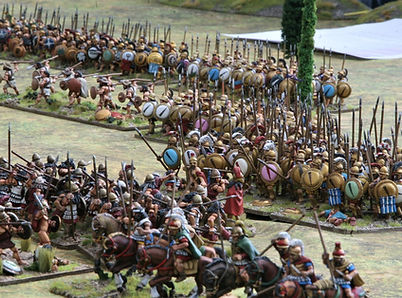
FINAL Note
Hoplomachia never tries to compete with broader "sword and shield" systems like DBMM, Field of Glory, or Hail Caesar. It's a pure passion project, laser-focused on a single military culture and era. That focus has earned it a loyal cult reputation among hoplite enthusiasts. Yes, the heavy use of Greek terminology and the layered mechanics can make the system intimidating for newcomers. The 59-page PDF is little more than a dense WORD document, devoid of illustration or chrome. But for those willing to wade into the Peloponnesian War, Hoplomachia is a deeply rewarding, innovative approach to wargaming the period.
Downloads
Additional reading
REFERENCES
The Perfect Captain Homepage
RELATED GAMES
Field of Glory (Osprey Games, 2008)
Age of Hannibal (Little Wars TV, 2018)
Clash of Spears (Fighting Hedgehog, 2018)
Men of Bronze (Osprey Games, 2020)