Alamo Ruleser
Author: David Good, Ron Prillaman & Rich Hasenauer
Publisher: Little Wars TV, 2022
Period: Horse & Musket; Texas Revolution
Scale: Skirmish
LIBRARIAN'S SUMMARY
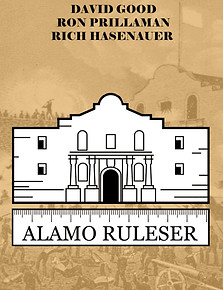
A true relic of the golden age of convention wargaming, the Alamo Ruleser is exactly what its name suggests: a complete game printed on a ruler! Designed in the 1980s by Ron Prillaman and Richard Hasenauer, it powered rowdy, multiplayer convention games recreating the final assault on the Alamo. Every mechanic is stripped down to its barest essentials: movement by handfuls of d6, combat resolved with single opposed rolls, and just enough chrome—ladders, gates, cannon, and morale—to bring the battle to life without slowing it down. The modern update by David Good preserves that original spirit while refining the format. But yes, the newest iteration does still fit on a ruler! Little Wars TV packaged this ruler with a complete Alamo scenario, ready to play!


WHAT YOU NEED
Playing the Alamo Ruleser demands a proper spectacle! The scenario is built around 1:1 scale miniatures, with hundreds of individually based figures representing both Texian defenders and the attacking Mexican columns. The original setup calls for a 5’ x 7’ table to accommodate the full Alamo complex, though this can be scaled up or down depending on your available space and figure collection. Terrain is critical to the experience—you’ll need a representation of the Alamo itself, including its chapel, Convento, gatehouse, surrounding walls, and key defensive features like ditches, and abatis. A healthy supply of six-sided dice drives the entire system, along with casualty markers to track losses and morale. While the game can be played with fewer participants, it clearly shines as a multiplayer experience, with several players dividing command of the Texian defenders and Santa Anna's columns.
Everything needed to set up your own version of the Alamo scenario, including orders of battle and the map, are included in the download with the rules. But creative, enterprising gamers will find the minimalist nature of the rules widely adaptable and suited for just about any "last stand" assault. Rorke's Drift? The defense of the Peking legations during the Boxer Rebellion? Even medieval castle assaults like Jerusalem or Constantinople could be gamed using a modified version of the Ruleser. The possibilities are intriguing....
HOW IT PLAYS
-
MOVEMENT: Texians first, then Mexican attackers
-
TEXIAN REACTION: Texians may make a second move if they saved move dice
-
FIRE: Texian shooting, then Mexican shooting
-
MANO-a-MANO: Close combat for all figures in contact
-
RESERVES: Mexican losses recycle and morale is updated
The Alamo Ruleser is so incredibly concise that any written summary is bound to be longer than the game itself! Fundamentally, this is a game about momentum and pressure. The Mexican army advances in relentless, recylcing waves, while the Texian defenders scramble to hold the line, reposition, and inflict as many casualties as possible before the walls are inevitably breached. The turn sequence is simple and intuitive, alternating between movement, fire, and melee, with a clever Texian reaction phase allowing the defenders to respond dynamically to the attackers’ advances. Movement is entirely dice-driven, with each side rolling a pool of d6 to determine how far their forces can move in a given turn. This creates friction and unpredictability—some assaults surge forward, others stall at the worst possible moment.
Fire combat uses straightforward d6 rolls with different thresholds depending on troop quality, while melee is resolved through quick opposed rolls modified by factors like numbers, cover, and leadership. The result is fast, decisive engagements that keep the game moving even with large numbers of figures on the table. Terrain plays an outsized role in the experience, effectively acting as a system unto itself. Ditches and abatis disrupt movement, gates must be battered down before entry, and ladders create dangerous choke points along the walls.
Perhaps the most distinctive mechanic is David Good's addition of a Mexican reserve system. This did not feature in the original 1980s design. Rather than simply removing casualties, fallen soldiers are recycled into fresh units, creating a constant stream of reinforcements. However, each column tracks its own losses, and as casualties mount, it becomes increasingly difficult to bring new troops onto the table. This creates a powerful sense of mounting pressure and attrition, capturing the relentless nature of the historical assault while still giving the defenders a meaningful way to stem the flow.
The victory conditions of the scenario paired with the Ruleser make the Alamo a playable experience for both sides. Instead of forcing a historically inevitable outcome, the game reframes success for each side. The Mexican player wins by capturing key objectives and eliminating Texian leaders, while the defenders measure victory by the number of casualties they inflict. If the Texians can bloody Santa Anna’s army badly enough, they achieve a moral—or even strategic—victory despite being overrun. This simple shift transforms what could be a foregone conclusion into a tense and competitive game.

FINAL Note
The Alamo Ruleser is a perfect example of old-school wargame design at its best. It was created for convention play—big games, lots of players, and constant action—and that DNA is evident in every part of the system. For modern players, it offers something increasingly rare: a large-scale skirmish game that is both accessible and fast-playing, without sacrificing the narrative drama of the historical event. The fact that it was originally designed to fit on a ruler is not just a gimmick—it’s a statement of intent. Everything you need, nothing you don’t. The Alamo Ruleser is a "beer & pretzels" game in the truest sense. The emphasis here is on speed of play and fun. And dammit, it's awesome.
Downloads
Additional reading
REFERENCES
RELATED GAMES
Sword & the Flame (Larry Brom, 1979)
Song of Drums and Shakos (Ganesha Games, 2008)
Sharp Practice (Too Fat Lardies, 2008)
The Men Who Would Be Kings (Osprey, 2015)