Jay White


The Wargame Library Speaker Series continues with Jay White, author of This Hallowed Ground, as well as Empires at War, Beat to Quarters, and more. Visit his blog, Jay's Wargaming Madness, to learn more.
Your blog has become quite the hub for your free rules. What motivated you to start developing and publishing your own systems?
As a baseline I try to avoid writing my own rules and try to focus on first creating a solid rules reference for an existing system. Early on I did that for a large number of rule systems and used my blog to share my work with the general wargaming community (sharing means caring!) and it was a helpful way to be able to find things (I play a lot of different periods). I was (pleasantly) surprised by the number of people who used what I created. When starting new periods I often ordered several sets of rules to try out to see what we liked and worked for our specific gaming objectives - which is primarily the ability to do historically based battles we can play in 4-6 hours (typically nice weekend gaming day). We also attend all the local conventions and host large games, so often the rules had to be easy to learn, work with a large scenario, and large group of people.
The benefit to playing so many systems (or perhaps the drawback?) is it really fuels some creative thinking. I like the how command and control is handled by these rules, the shooting from this other set, and so on. Over the years and having played so many different systems I can quickly formulate rules I think will work for the large games I want to run. Honestly, nothing I did was purposefully done for the masses - it was purely for my group and I just fell into having created something others started using.
Across many of your games, there's a recognizable core engine. What are some key principles you like to emphasize in your games?
Overall I think a balance must be achieved between command and control, movement, shooting, and melee. I don't want any one of those concepts to "take over" the rules system. Commands should be well defined to declare intentions, but become more unpredictable as to the results when units wear down and the battle rages. Shooting - I like to roll dice. Roll a D6 or two and divining some large number of results from that isn't satisfying to me. Probably because I'm crap at rolling dice. I think rolling more dice tends to make players feel like they have a better chance, even if the math comes out the same. Finally, close combat/melee - whatever you want to call it - this is the tricky one to me. I think almost every game I've played bogs down in melee. In some ways it is unavoidable if you want that historical flavor. I think I can do better here, but my foundational principal here is to completely resolve the melee in a single turn. No ongoing melees spanning several turns. In games where you may only get 4-6 turns before a decisive outcome, you can't have units locked up for multiple rounds. The system must keep things flowing.
You've mentioned before that your morale system is inspired by Kings of War. Are there any other games that offered you design ideas?
Oh yes. I have to point out Fire and Fury 1.0 from back in the 90s. I spent many and hour as a kid rummaging through the pages of that book. Transformational for its time visually speaking. Bolt Action and Black powder have had the largest influences on my approach to rules because they tend to work well for conventions and groups of 4-6 players. Force and Force for modern has some great concepts for theatre specific battles/campaigns. My collection of wargames rules is fairly significant from over the years. Points to anyone who remembers the "McCoy" WW2 System from Wargames Digest back in the 1980s (which I played with my father).
For the American Civil War, what specific twists did you feel needed to be added to the game to give it the right sense of historical flavor?

Perhaps very non-historically, I have a vision for what I want a game to look like as it is being played before I know how it will be played. The look of the units and formations, scenery, what the battle looks like when you are properly stuck in, and so on. The basing of 6 figures on a 45mm x 40mm base in units of typically 5 bases (30 figures) I felt provided the right balance of density of the units along with enough bases to show historical formations (always a fan of the "snaking" units lined up against fences). I believe that historical flavor is as much what we visually get out of a game as it is how the game is played. That is not to detract from the fact the rules must make the game fun.
When I think of the American Civil War it always has stood out to me just how bloody it was. A strange period in time where outdated rank and file tactics met with the lethality of modern weapons (speaking in broad terms). I felt that shooting had to be nasty, and that melee had to be resolved quickly and at great expense. The rules in some ways must force players to think of the consequences of historical tactics. I can charge into melee here, but the majority of the time that unit will be beaten up just as badly as the unit if may break. As a result I'll need to quickly reinforce that push on the field. You can't do that everywhere, and if you don't think things through you'll find yourself on the "back foot" very quickly. I think historical flavor purely from the rules is insufficient - you must combine the rules with historical scenarios to complete the picture. Lining up a pitched battle of blue versus grey like a "Warhammer" tournament game will never be historically satisfying no matter what rules you play. But stick someone in the situation of having to make that fated attack by Pickett's division against the Union lines at Gettysburg, with all the units and scenery to go with it ... THAT is historical flavor. Of course, there are limits to everything. You want to go hard core? Dress up in the wool, dump a jar of fleas down your trousers, and chomp on some hard tac while trying not to black out from the heat because you'll land on all your nicely painted miniatures!
By requiring different numbers of successes, the order system in This Hallowed Ground does a nice, clean job representing how not all orders are equally easy for men to carry out. A Hold order is easier to issue than a Charge! The condition of the unit also influences the likelihood of orders being implemented. How did you develop your order system? It feels like it's the heartbeat of the game system.
Agree. The command system is the heart of that game. It was inspired by the orders dice from Bolt Action. I hard lesson learned after hosting so many games at conventions was that giving players very open ended or poorly defined orders to "choose" from always become problematic. Either they lacked the engagement to think so ended up staying static and doing nothing, or they tried doing unrealistic flank marches around the convention room. Horrible! So I took a similar approach by defining the basic orders you can issue - making sure the covered the spectrum of things a player wants to accomplish during a game. I equally like the concept of the state of a unit being fresh, worn, or shaken. That allowed me to define the complexity of the order and leverage of the unit state to add the unpredictability of command into the system, but in a way that doesn't require extensive charts, percentages, or a massive system of command and control. Choose and order, roll a few dice, see what happens. The "exploding 6's" concept I've always like as I believe it to be a balanced method for adding just that little bit of 'hope' into the system (not for me, I have no hope with dice).
No one likes to pick favorites! But do you have a favorite game of your large stable of free systems?
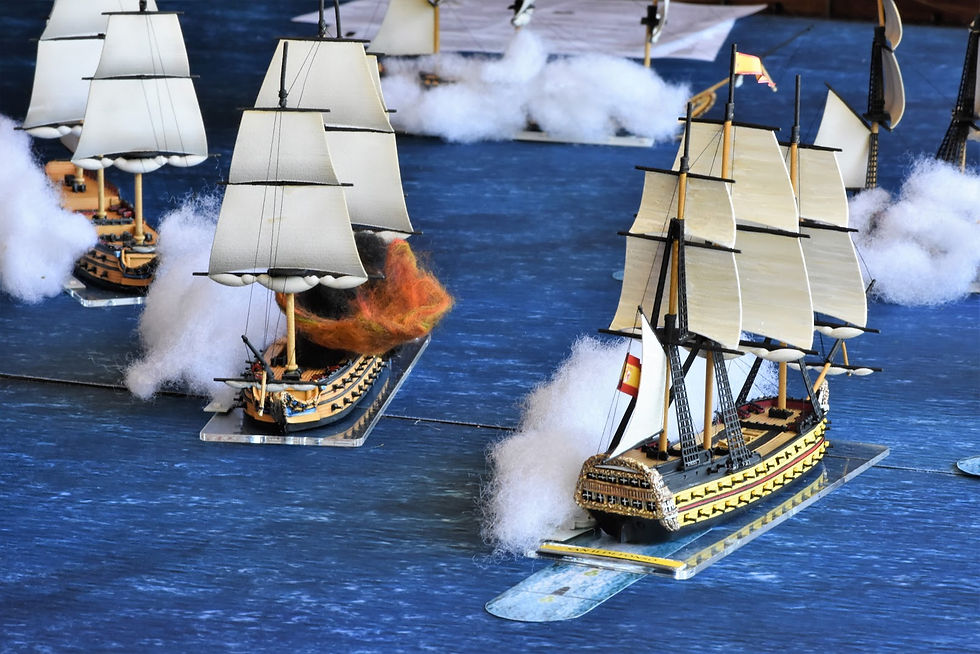
This Hallowed Ground (ACW) is of course a favorite and one I likely put the most time into. Beat To Quarters - 1/300 scale (Old Glory) Napoleonic naval is a spectacle to see in person and a lot of fun! Finally, while I have not played for some time due to the sheer amount of projects I've been working on, Bolt Action Modern (BAM) playing asymmetrical scenarios has always been enjoyable.


Comments