1898 Jane Naval War Game
THE CLASSICS
Author: Fred T. Jane
Publisher: Sampson Low, Marston and Co. (London), 1898
Period: World Wars
LIBRARIAN'S SUMMARY
Jane’s 1898 Naval War Game is one of the earliest commercially published wargames designed to simulate modern warfare with a serious, quasi-professional intent. Created by Fred T. Jane—better known for All the World’s Fighting Ships—the game sought to model the capabilities of contemporary warships, their guns, armor, and tactical maneuver in a playable tabletop format. Unlike earlier abstract games, Jane’s system attempts a granular representation of naval combat, where individual ship types and weapon systems matter. While primitive by modern standards, it represents a bold effort to bridge the gap between professional naval thought and civilian hobby gaming, offering players a chance to explore tactical problems in a structured but accessible way.

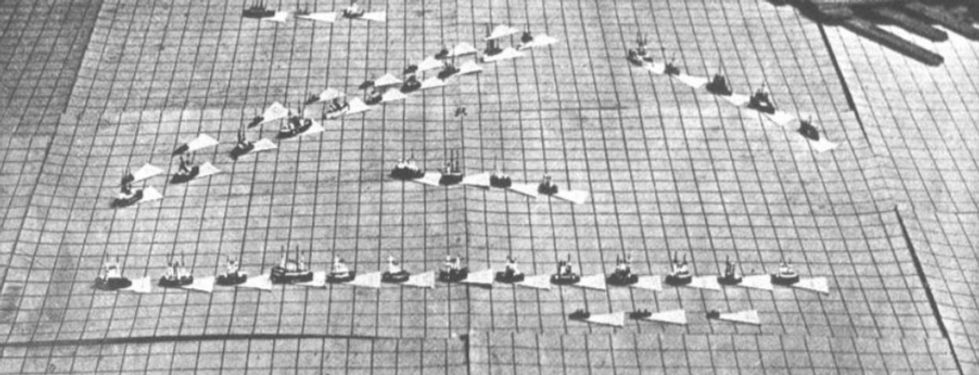
"No tactical problem can be worked out on a basis of certainty of hitting."
-Fred Jane


Legacy
First published in 1898, Fred Jane’s naval wargame sits at a critical junction in the history of the hobby. Building on the foundations of Kriegsspiel, it helped push wargaming out of purely military circles and into the public sphere. Its publication alongside Jane’s reference works created one of the earliest examples of a commercial wargaming ecosystem—rules, data, and models all reinforcing each other.
The involvement of naval officers in its development and testing gave it credibility, even if adoption within official institutions remained uneven. While some naval officers of the late Victorian period viewed Jane as a civilian outsider, he was widely respected in many professional circles. Notably, by senior British officers like Henry John May. A 1904 article from London's Strand Magazine is included under the Wargame Library downloads, and this piece shows how contemporaries viewed Jane's novel new wargame.
Jane's legacy for modern wargaming is unquestionable. He was a miniature wargaming enthusiast himself, and his game system demonstrated that complex warfare could be explored through structured play. Though later overshadowed by more refined systems, its DNA can be seen in everything from early 20th-century naval games to modern simulation-heavy designs.
HOW IT PLAYS
Jane’s naval war game is built as a simulation first, game second, and that philosophy is evident from the outset. As he explains in the rules, the goal is to create “a thorough sea equivalent to the Army War Game… by which any problems can be worked out with the greatest possible simulation of actuality.” The system is designed not just to entertain, but to explore real tactical questions. Gameplay centers on maneuvering individual ships or squadrons using measured movement and physical tools to approximate real turning arcs and speeds. This is not abstract movement—Jane explicitly wanted players to grapple with the realities of handling ships, noting that maneuver is governed by “a convention” that rewards patience and careful execution rather than quick, gamey shortcuts.
Combat is where the system becomes most distinctive...and most demanding. Gunnery is resolved through a mix of probability and physical representation, with ships modeled in enough detail that even small components can be targeted. Jane emphasizes that “every individual type of ship… every individual gun and projectile… is allowed for,” reflecting his ambition to capture the technical realities of naval warfare. At the same time, he is clear-eyed about the limits of simulation. The game deliberately incorporates uncertainty, because “no tactical problem can be worked out on a basis of certainty in hitting.” Accuracy is even adjusted upward from reality to keep the game moving, a practical compromise to avoid endless turns with inconclusive results.
This tension—between realism and playability—defines the experience. The mechanics can be slow and occasionally cumbersome, but they force players to think like naval commanders balancing firepower, maneuver, and risk. Jane himself acknowledged that superior results often come not from gunnery alone, but from how forces are used. In practice, the game is less about winning in a competitive sense and more about testing ideas. It invites players to experiment, to take risks, and to discover how fragile even well-laid plans can be once uncertainty and imperfect information enter the equation.

Final Note
Jane’s 1898 naval wargame is not a system most players would reasonably attempt to play today. But that’s not really the point. Its value lies in what it represents: one of the first serious attempts to make modern warfare playable on the tabletop for both professionals and enthusiasts. For the Wargame Library, it belongs firmly in the classics category as a historically significant design that helped shape the hobby’s trajectory. Approach it with curiosity rather than expectation, and it offers a fascinating glimpse into the early evolution of wargaming.