Fire at Sea
Author: Mark Fastoso
Publisher: Mark's Game Room, 2021
Period: World Wars
Scale: Skirmish
LIBRARIAN'S SUMMARY
Fire at Sea: The Battle of the Denmark Strait is a scenario-driven wargame that recreates one of the most famous surface actions of the Second World War in May 1941. The game strips naval warfare down to its dramatic essentials—maneuver, ranging shots, catastrophic damage, and the ever-present possibility of a lucky magazine hit ending a ship in a single thunderous moment. In just a few well-illustrated pages, Fire at Sea focuses on creating a tense cinematic duel that can be played in an evening. The system uses a clever combination of dice and standard playing cards. As an introductory game for newer players, it is especially accessible and easy to learn. The author continues to support the game system with additional campaigns, both for free and for sale.


WHAT YOU NEED
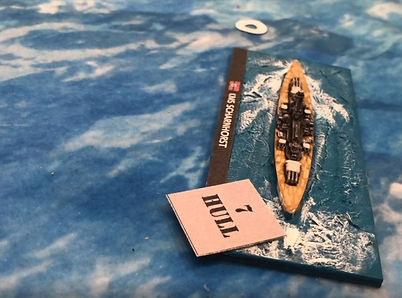
The game requires only four ships—Bismarck, Prinz Eugen, HMS Hood, and HMS Prince of Wales—along with a 4' x 4' gridded sea mat, two six-sided dice, two standard decks of playing cards with the jokers removed, splash markers, and the included captain cards that provide special abilities and command ratings. While written with 1/2400 scale miniatures in mind, the rules also include paper ship counters for players who want to get started immediately. It's hard to imagine an easier, faster entry point to historical wargaming than this. The only hurdle at all is the necessity for a gridded mat, but players could create grids by laying beads or tokens in a pattern to simulate the grid corners if a lined playing mat is not in their collection.
HOW IT PLAYS
-
MOVEMENT: British movement, then German movement
-
SHOOTING: Simultaneous fire resolution
-
DAMAGE CONTROL: Attempt to repair damage
-
MORALE: Ships with hits from the turn check morale
Fire at Sea is built around a simple command system that gives each captain a limited pool of "Captain's Points" to spend every turn. These points can be committed to improving gunnery, helping a ship make difficult maneuvers, repairing damage, or stiffening a crew's resolve during morale checks. Because the same resource fuels every aspect of command, players are constantly making tradeoffs. Do you spend points to improve your odds of landing a decisive salvo this turn, or save them in case damage control becomes necessary later?
A gridded playing area makes movement exceptionally easy. Rather than tracking knots or plotting with turn gauges, each ship makes a speed roll to determine whether it can move forward into a new grid space or alter course and change direction. Damage can make these rolls progressively harder, representing crippled engines or steering problems without introducing bookkeeping. Gunnery is, likewise, very easy to resolve. As ships continue firing at the same target, they place splash markers in the enemy's square. Each marker improves future shooting, creating a sense of crews gradually finding the range. And when shells strike home, the game shifts to a card-driven damage system. Every successful hit generates one or more damage cards, with heavier ships at closer ranges capable of producing devastating chains of additional cards. The armor tables for each ship determine which cards actually inflict damage, giving the major warships distinct defensive personalities.
After the shooting concludes, crews attempt damage control. Captains can spend precious command points to repair damaged systems and keep their ships fighting. Not all damage can be fixed, however, and failed repair attempts may become permanent. This creates a gradual attritional element as ships accumulate problems that can no longer be remedied, slowly degrading combat effectiveness. Ships that take punishment must check whether their crews maintain their fighting spirit. Failed morale affects both maneuver and gunnery, and victory is determined not only by sinking enemy ships but also by breaking their will to continue the action.
Decisions are meaningful, the rules move quickly, and the splash-marker and damage-card mechanics generate a surprisingly convincing narrative of ranging shots, mounting damage, and sudden catastrophe. It is a game that consistently produces stories—exactly what most players hope for when refighting the Battle of the Denmark Strait. The use of custom Captain Cards adds some nice chrome to the game, allowing the personalities of famous naval officers to give certain bonuses.
FINAL Note
Fire at Sea is clearly a "beer-and-pretzels" gaming experience, but it does capture the feel of the Denmark Strait action remarkably well. Players experience mounting damage, command decisions under pressure, and the ever-present possibility that a single shell may decide the battle. The game's greatest strength is accessibility. New players can learn the rules in minutes, yet experienced gamers will still find interesting choices in how they allocate command points and manage morale. For anyone curious about naval gaming but intimidated by more complex systems, this is one of the easiest and most enjoyable entry points available.
Downloads
Additional reading
REFERENCES
"Bitter Enemies" Scenario book
RELATED GAMES
General Quarters (Old Dominion, 2006)
Naval Thunder (Steel Dreadnought Games, 2009)
Victory at Sea (Warlord Games, 2020)