Balagan's Marlburian rules
Author: Steven Thomas
Publisher: Steven's Balagan, 2001
Period: War of Spanish Succession
Scale: Big Battle
LIBRARIAN'S SUMMARY
Balagan’s Marlburian Rules are the lean, original spark behind what would later become Twilight of the Sun King. First published as a blog post in 2001 and later refined for print, these rules represent a design philosophy that prioritizes speed and battlefield feel over granular simulation. Written for the War of the Spanish Succession, they strip the period down to its essentials: linear warfare, command friction, and morale collapse. What makes this system remarkable is how much it achieves in just two pages. Units are abstracted into just two elements per brigade, combat is resolved entirely through morale, and turns flow quickly with minimal bookkeeping. It’s not just a prototype or demo—this blog post stands on its own as a fully playable wargame design.


WHAT YOU NEED
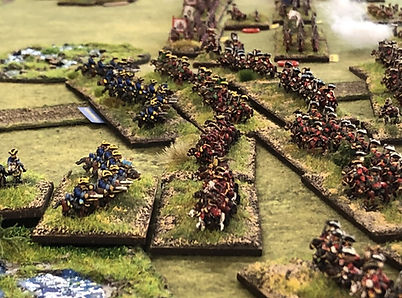
The original blog post rules are intentionally minimal--the author explicitly states his intention to design a two-page system for large battles of the 18th Century. In this, he succeeded...the game is actually less than two pages! Each unit consists of just two elements (bases), representing a brigade of infantry, cavalry, or artillery. The game was designed with 6mm figures in mind, emphasizing affordability and the ability to stage large battles. A standard table, some terrain, and a handful of six-sided dice are all that’s required. Morale loss can be tracked on a paper roster or using tokens on the table. The blog Steven's Balagan does include additional posts from the author proposing army lists, nationality differences, and a points system. Those posts are linked below as additional reading. Something sorely lacking for this game--and a primary reason Twilight of the Sun King replaced it--are historical scenarios. The 2001 blog post provides a highly playable system but leaves you wondering exactly how to start your first battle or what a proper army order of battle would look like. This must be inferred and pieced together from additional posts about army building.
HOW IT PLAYS
-
MORALE: Active player tests morale for units in combat
-
ACTIONS: Active player moves or attempts an action with each unit
-
ALTERNATE: Opposing player takes his half of the turn as above
Each turn represents roughly 15 minutes of battlefield time. "Units" are brigades and maneuver in historically appropriate formations—line, column, or double line. These choices matter. Line offers combat effectiveness, while column provides speed but comes with penalties. Cavalry, infantry, and artillery each have distinct movement and battlefield roles. All ranges and distances are provided in "paces" which a player converts to centimeters. It's an easy conversion (100 paces = 1 cm) but it would have been nice to just use the centimeter reference for ease.
The turn sequence is concise. Each player completes their half of the turn, called a "bound," with just two steps. First, units must test morale if they are in combat. Second, units may move or attempt an action. Actions may include formation changes, charging, and wheeling. While movement is automatic, any action requires a 3+ test on a d6. It's easy to remember and provides the only basis for command friction in the game.
The real emphasis here rests on the morale system. Combat—whether firing or melee—is not resolved through casualties, but through morale tests. Players total situational modifiers (terrain, support, formation, flank exposure, etc.), roll a d6, and compare the result. Poor results accumulate morale failures, and once a unit reaches its breaking point, it routs and is removed. Infantry can withstand more punishment, while cavalry and artillery are more brittle. The entire army is also subject to collapse. Once enough units rout, the rest may follow in a cascading failure. The list of morale modifiers is a bit on the long side, which players may find surprising for such a tight, short game.
The two page game includes three Optional Rules players can adopt individually or ala carte. The rule for adding Generals is a "must add." Optional rules for an order system and fog of war slow play down enough to skip in your first session. Some design notes from the author appear at the end of the game discussing the philosophy and historical basis for the system. This is a welcome addition, but not as welcome a FAQ might have been. As you might expect for such a short game, there's some missing connective tissue and clarifications that pop up when you get this on the tabletop.
FINAL Note
It's tempting to call this 2-page system "Twilight of the Sun King," because that is how the rules evolved. But back in early 2001 when Steven Thomas concieved the game, it did not have this title. That was a later addition from future co-author Andrew Coleby.
Balagan’s Marlburian Rules are a rare thing: a “first draft” blog post that is remarkably complete. Yes, there are a few holes and questions left unanswered, but for players who want to run large battles quickly this is an excellent basis for exploring 18th Century warfare. If Twilight of the Sun King is the finished painting, these rules are the original sketch—and in many ways, just as compelling.
Downloads
Additional reading
REFERENCES
Twilight of the Sun King publisher page
RELATED GAMES
Black Powder (Warlord Games, 2010)
Beneath the Lily Banners (League of Augsburg, 2009)
Twilight of the Sun King (Pike & Shot Society, 2010)
Black Powder (Warlord Games, 2010)
Maurice (Honour Games, 2012)